
Clinical Chemistry
Contributed by Tanner Bartholow, MD, MS and Steven Dobrowolski, PhD
PATIENT HISTORY
A five-day old female presented to the Emergency Department, without symptoms, following parental notification of an abnormal newborn screen. No abnormal findings were noted on the patient's physical exam.
The patient's mother was a gravida 4, para 4004, 35 year-old, with no history of alcohol, tobacco, or recreational drug usage. The mother took prenatal vitamins and had no history of gestational diabetes. Pre-natal ultrasounds showed a nuchal cord, and a Cesarean section was performed at 38 weeks and 2 days gestation with no complications.
On the newborn screen, the patient's succinylacetone level was 7.63 µmol/L (Reference range - < 1.88 µmol/L).
A basic laboratory work-up was performed while the patient was in the Emergency Department:
- Na - 140 mmol/L (133-146 mmol/L)
- K - 4.7 mmol/L (3.7 - 5.9 mmol/L)
- Cl - 107 mmol/L (98 - 107 mmol/L)
- CO2 - 21 mmol/L (21-31 mmol/L)
- Anion gap - 17 mEq/L (10-14 mEq/L)
- Glucose - 93 mg/dL (93-115 mg/dL)
- Ca - 10.0mg/dL (7-12mg/dL)
- ALT - 22 IU/L (14-54 IU/L)
- AST - 51IU/L (24-95 IU/L)
- Alkaline Phosphatase - 248 IU/L (< 310IU/L)
- Total bilirubin - 6.4 mg/dL (1-12 mg/dL)
- Alpha fetal protein (AFP) - > 54,000 ng/mL
- NH3 - 92 µmol/L (critical value)
- Lactate - 3.4 mmol/L (0.5 - 2.2 mMol/L)
The elevated lactate and ammonia levels were attributed to the difficulty with the venipuncture (based upon clinical determination), and the patient's family were instructed regarding outpatient follow-up.
Further patient work-up included a serum amino acid analysis, as well as a urine organic acid analysis, the latter of which was initially conducted with a trimethylsilyl derivatization (Figure 1 and Table 1), and subsequently, with an oxime derivatization (Figure 2, Table 2).
Serum amino acid analysis (select values displayed, not inclusive of the entire analysis)
- Tyrosine - 68 µmol/dL (<18 µmol/dL)
- Methionine - 3 µmol/dL (<8 µmol/dL)
- Lysine - 20 µmol/dL (<33 µmol/dL)
- Proline -32 µmol/dL (< 53 µmol/dL)
- Hydroxyproline - 14 µmol/dL (<10 µmol/dL)
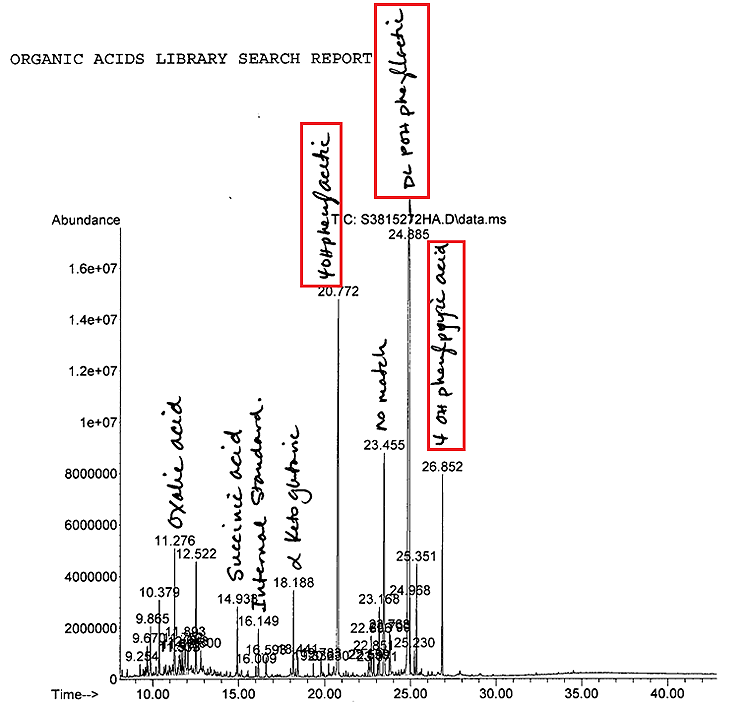
| Compound | Abundance |
|---|---|
| 4-hydroxyphenylacetic acid | 13.83 |
| Para hydroxyphenyllactic acid | 31.45 |
| 4-hydroxyphenylpyruvate | 4.35 |
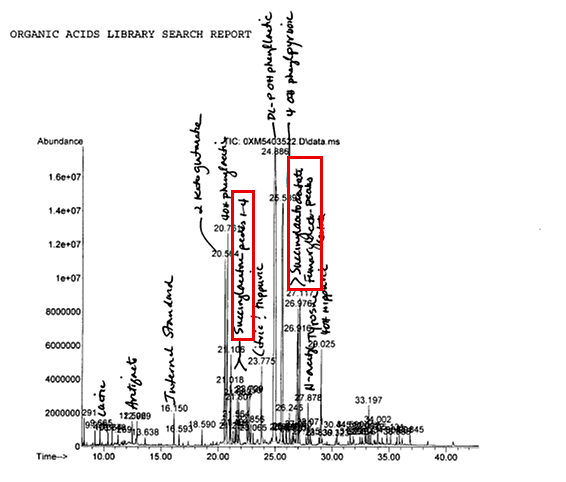
| Compound | Abundance |
|---|---|
| Succinylacetone (4 peaks) | 0.46, 0.84, 1.47, 1.11 |
| Succinylacetoacetate (3 peaks) | 6.77, 4.42, 5.22 |
| Fumarylacetoacetate | 0.32 |
Following these results, appropriate therapy was initiated. The patient's subsequent succinylacetone level was 1.90 µmol/L (Reference range - < 1.88 µmol/L). The subsequent tyrosine level was 4.78 mg/dL (Reference range - <4.98 mg/dL).